
How We Cut Consumption Reporting Time by 3x for a Leading Indian Specialty Coffee Brand
Discover how Aays helped one of India's fastest-growing coffee chains enable faster reporting, lower infrastructure costs, and build a scalable foundation for analytics by replacing their scattered data systems with a unified Databricks Lakehouse.
About the Client
Our client is one of India's leading specialty coffee chains. With over 90 cafés across six cities, the brand has built its name on ethically sourced Arabica beans, in-house roasting, and community-driven cafe experiences.
As the business expanded rapidly, fragmented systems across store operations, inventory, and customer data created manual reporting bottlenecks, making it difficult to support the real-time decision-making needed at their scale.
The Problem
Data Was Scattered Across Multiple Systems
Data spread across Azure Synapse, AWS RDS, and custom ETL scripts, each operating in isolation with no shared schema or sync between them
Generating a single leadership report meant pulling numbers from three separate systems by hand and manually reconciling the ones that didn't match
Duplicated data drove up infrastructure costs and created governance and consistency issues
The client needed one platform that could replace this patchwork and scale with them.
The Solution
Building a Unified Databricks Lakehouse
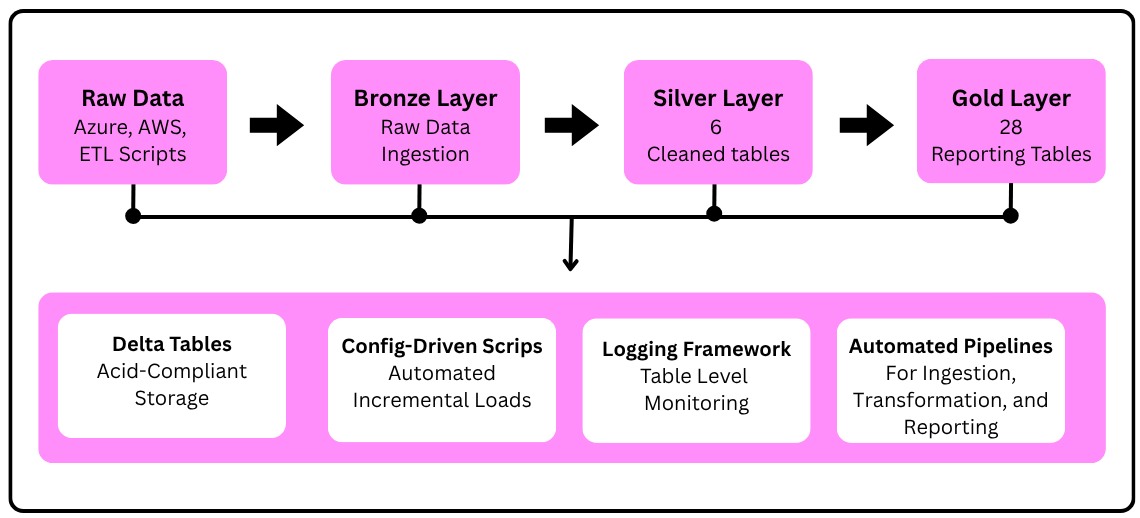
We migrated the client's entire data ecosystem, including 54 MySQL tables from AWS RDS and 58 MSSQL tables from Azure, all onto Databricks. On top of this foundation, we built:
- Medallion Architecture: Organizing data into Bronze, Silver, and Gold layers so raw data gets progressively cleaned, refined, and made analytics-ready. We built 6 Silver tables and 28 Gold tables for reporting.
- Delta Tables: Giving the client reliable, ACID-compliant storage that scales as data volumes grow.
- Dynamic, Config-Driven Scripts: To manage incremental data loads and handle edge cases automatically, instead of requiring manual intervention.
- A Logging Framework: That captures success and failure at the table level, so issues surface immediately instead of hiding in a spreadsheet somewhere.
- Automated Data Pipelines: For ingestion, transformation, and reporting.
We also optimized compute resources and Spark workloads to improve speed and reliability. Along the way, we ran into challenges, including out-of-memory errors during historical data migration. We diagnosed the bottlenecks using Spark UI's Executor and Storage tabs, then resolved them by increasing executor memory and switching to memory-optimized instances.
The result was fully automated, governed pipelines, orchestrated end-to-end through Databricks Jobs.
The Impact
Faster Analytics with a Single Source of Truth
The client now operates on a unified Databricks Lakehouse that supports faster reporting, better governance, and scalable analytics.
Why it Matters
A Scalable Foundation for What's Next
As businesses grow, scattered data systems become harder and more expensive to manage. This project shows how consolidating data onto a modern Lakehouse architecture can simplify operations, reduce costs, and give business teams faster access to reliable data. With a scalable foundation now in place, the client is well positioned to support future analytics, AI, and machine learning initiatives as they continue expanding across India.