
How We Helped a Fortune 100 CPG Company Protect Profit Margins
Discover how Aays helped a global consumer goods giant uncover that 25% of its promotional sales jump was an illusion. Learn how the advanced analytics system we built helped them stop running discounts that were secretly losing money.
About the client
The client is a premier Fortune 100 consumer goods giant that owns a massive portfolio of household name brands across the globe. They manage some of the world's most widely recognized personal care, health, and hygiene products. At an enterprise of this magnitude, the money spent on supermarket discounts and store promotions represents their single largest flexible expense after the cost of raw manufacturing itself. This makes it a multi-million dollar budget line that directly impacts their profit margins.
The Problem
Promotional Blind Spots Across 1,000+ Stores
When the client put their products on sale, their grocery store sales numbers shot up immediately. Using their old spreadsheet planning system, the category team looked at these massive sales jumps and celebrated them as major wins. They assumed that because a promotion caused a massive 6.7x spike in the number of bottles sold, the discount was a huge success.
This left the team completely blind to the fact that their deepest discounts were actually destroying profit margins instead of making money.
Aays uncovered that roughly 25% of the client's big sales jump was a total illusion. The promotions weren't actually bringing in new customers to the brand. Instead, the data was being warped by two hidden problems:
- Forward-Buying: Shoppers weren't using more shampoo; they were just hoarding it while it was cheap. Customers stocked up during the deal week, which caused the client's sales to completely freeze and "dip" in the quiet weeks that followed.
- Cannibalization: A deep discount on a specific bottle size often just forced their regular shoppers to switch from another pack size they already owned. The client wasn't winning over rival brands, they were just moving coins between their own piggy banks.
It was physically impossible for a human team to manually sort through and separate these illusions across 1,028 stores every single week. Hence, the client kept funding money-losing promotions. They were caught chasing empty sales volume with no clear data or proof to challenge the numbers, leaving them unable to optimize their calendar for actual profit.
The Solution
Optimizing Trade Promotion Intelligence With Advanced Analytics
The RGM team had reached a breaking point. They knew they needed to stop chasing empty sales numbers and find a way to track actual profit.
The brand required a rigorous, data-driven way to strip out illusions and find the true incremental lift of every promotional dollar.
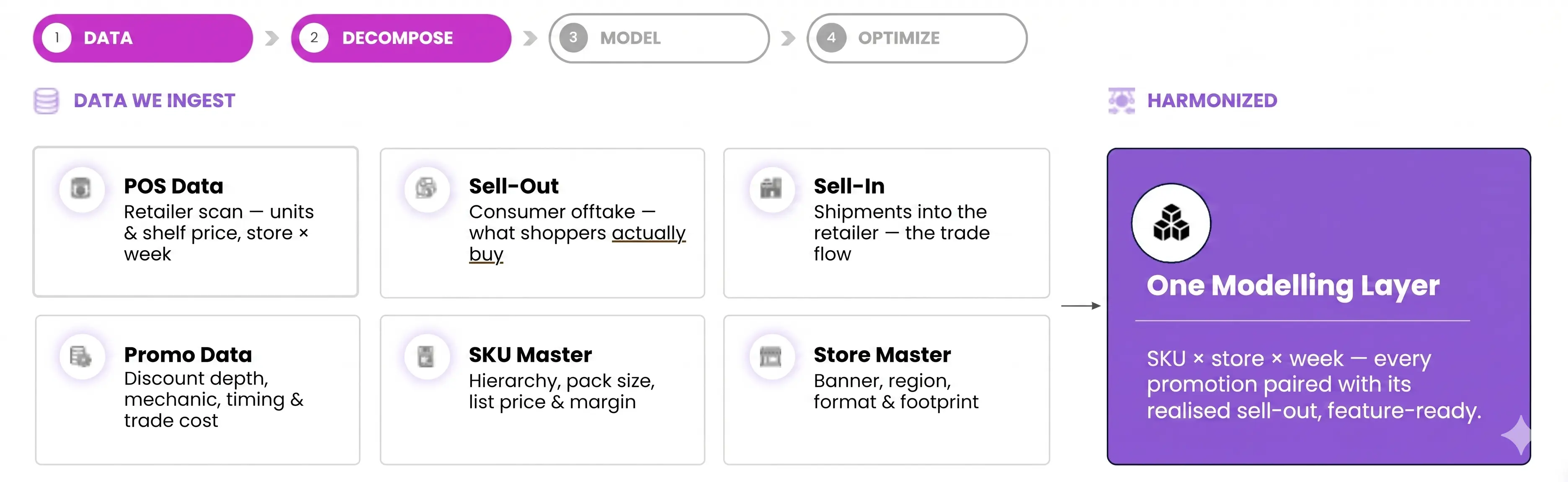
Aays deployed a Bayesian response-curve and optimization engine tailored for large-scale retail environments. The platform ingested 83,404 rows of structured retail data spanning POS scan units, shelf prices, promotional calendars, and SKU margins and applied a multi-layered approach:
- Bayesian MMM Architecture: Utilized Hill saturation curves and adstock carry-over to capture how discounts actually bend in real life.
- Blattberg-Neslin Decomposition: Applied proven theoretical frameworks to split sales spikes into what is genuinely real vs. what is pulled forward or stolen from sibling packs.
- MILP Profit Optimization: Fed the resulting true-lift curves into a Gurobi Mixed-Integer Linear Programming optimizer to automatically calculate the best depth and mechanic per promo.
The result was an interactive dashboard built with FastAPI and React, allowing planners to run live what-if scenarios, backed by an independent, 109-formula Excel cross-check to guarantee absolute auditability.
Instead of treating sales jumps as simple wins, the platform mathematically broke the sales spikes apart. It isolated real brand growth from fake volume, calculated exactly how deep discounts level off in the real world, and used a powerful optimization engine to pinpoint the perfect discount depth for every deal. The final solution was delivered as a fast, easy-to-use web app where planners can test "what-if" scenarios live, backed by a parallel Excel model to ensure total corporate trust.
The Impact
The brand moved from guesswork to complete clarity, immediately catching money-losing deals and proving that the deepest promotions (like 50% off) actually yielded an ROI under 1. By cutting out wasteful, non-incremental volume, the team unlocked a proven benchmark of 1 to 3 margin points back on promoted revenue across the portfolio.
To ensure the system could be trusted by top management, every single metric was tested against strict industry standards and verified by a parallel, non-coded spreadsheet system.
Why It Matters
In an industry where trade promotions are your biggest flexible expense, judging success based on raw sales volume is a massive financial risk. This project proves that advanced analytics isn't just about complex data science — it's about turning a deceptive sales spike into an honest, clear, and highly profitable growth strategy.